Quick note before we start: if you’ve read a citation-building guide before, you’ve seen the same advice every time: grab a spreadsheet, submit your name, address, and phone number to fifty or a hundred directories, and wait for the rankings to move. That advice made sense a decade ago. It doesn’t anymore. Google’s algorithm shifted away from rewarding citation count a long time ago, and now there’s a second, newer reason bulk submission wastes your time: AI platforms answering local search questions don’t scan a hundred directories either. They pull from four or five trusted sources per niche and ignore the rest. Building your business into those specific sources, instead of everywhere, is the actual work.
Quick Answer
- Citation volume stopped mattering years ago. Find the 4-7 directories Google and AI platforms actually cite for your niche and city, then go deep on those.
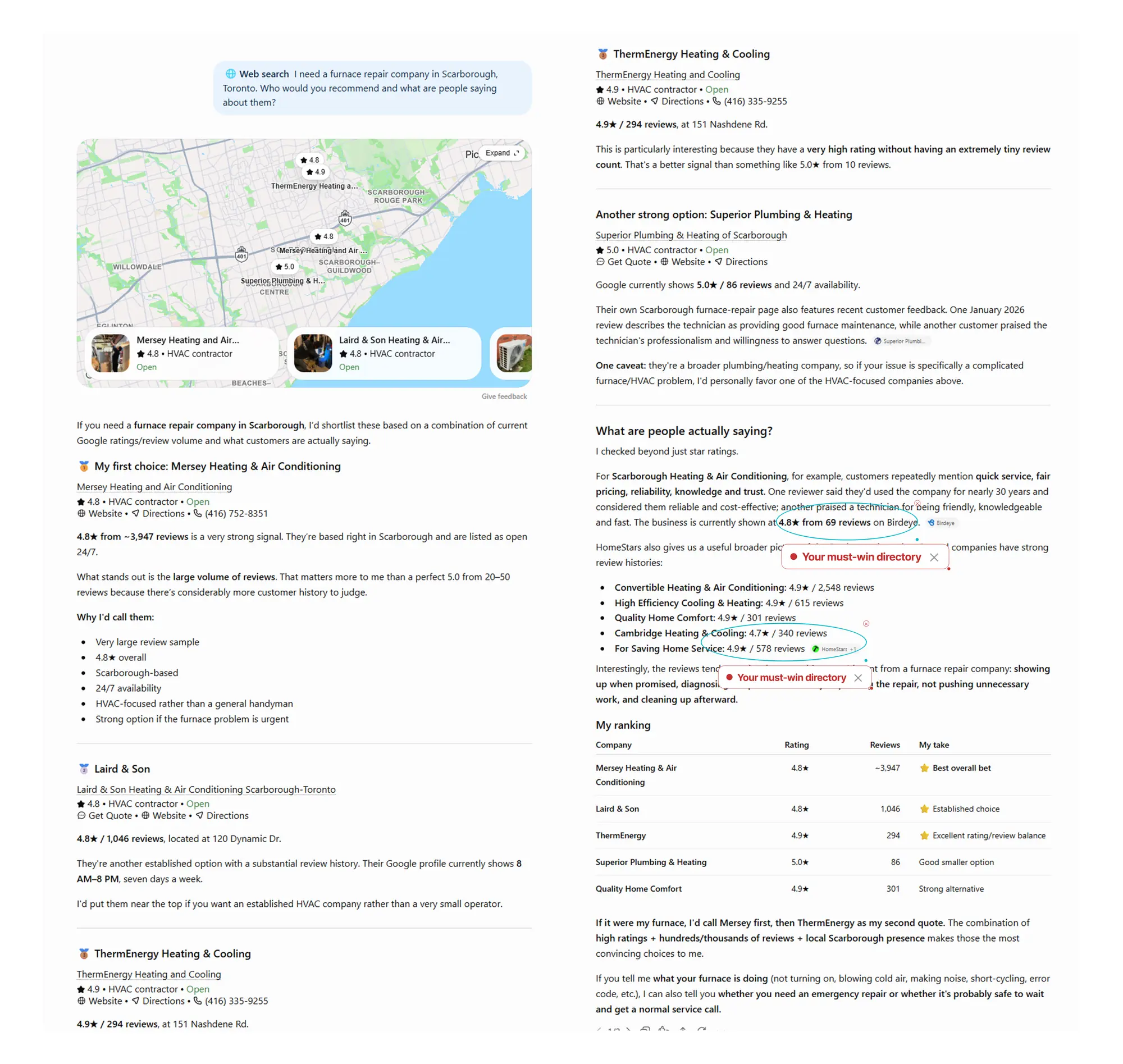
- Run your own target keyword through ChatGPT and Perplexity before building anything. The sites they cite as sources are your must-win list.
- NAP mismatches don’t just confuse Google. They cause AI platforms to state wrong facts about your business, since AI cross-references multiple sources to build its answer.
- Write directory descriptions in a subject-predicate-object structure: “[Business] is a [city] [service type] specializing in [X],” because that’s the sentence shape AI models parse most reliably.
- A well-optimized directory profile can rank in Google on its own, the same way a web page can. Most businesses leave theirs at the auto-filled default.
- Citations only pay off if the website behind them backs up the claim. A directory says who you are; your site has to prove it.
The 100-Directory List of Local Business Citations (And Why It’s the Wrong Starting Point)
Every citation-building checklist online opens with the same giant list of general directories. None of them tell you which four or five actually matter for your business.
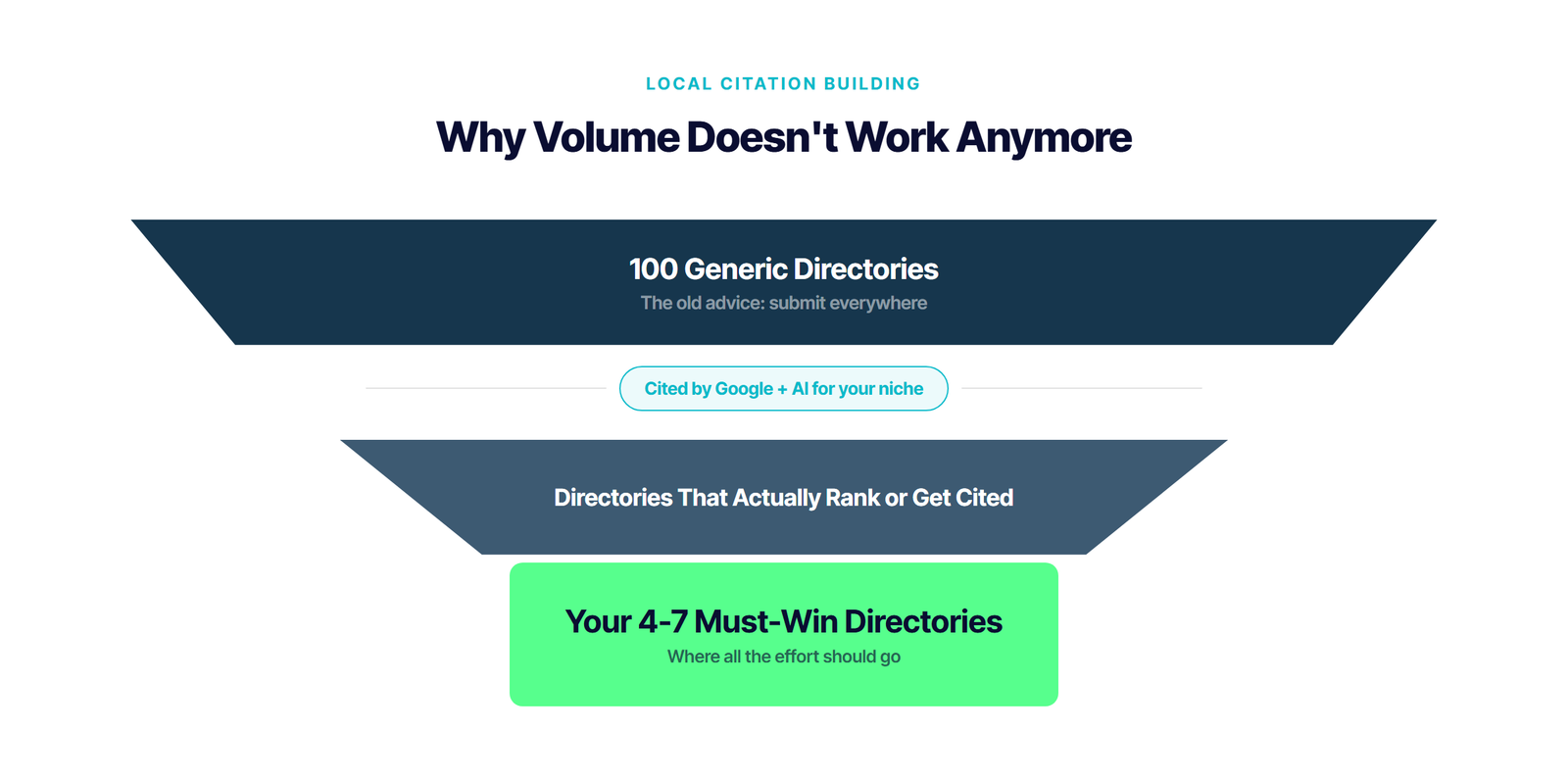
Search “local citation building” and you’ll find the same pattern every time: a master list of fifty to a hundred directories, sorted maybe by industry, with instructions to work through it top to bottom. It reads like more work equals more results. In practice, most of those directories carry no weight with Google and never get touched by an AI platform answering a local question. Your name, address, and phone sitting on a directory nobody checks isn’t a citation that helps you. It’s just a listing. The businesses that actually move on local rankings and AI visibility aren’t the ones with the most citations. They’re the ones with the right ones, fully built out, on the specific sites Google and AI already trust for their niche.
The Data Behind This
Whitespark’s annual Local Search Ranking Factors survey, the largest yearly poll of local SEO experts, has citation signals down to roughly 8 to 9% of the local ranking algorithm, continuing a multi-year decline. But the same report is direct about the flip side: in AI search specifically, brand mentions are becoming what backlinks used to be, and three of its top five AI-visibility factors are citation-related. Less weight for raw volume, more weight for the right few. That’s the whole shift this guide is built around.
Find Your Must-Win Directories First
Skip the master list. This is a 15-minute research pass specific to your exact service and city, not a generic industry list someone else built.
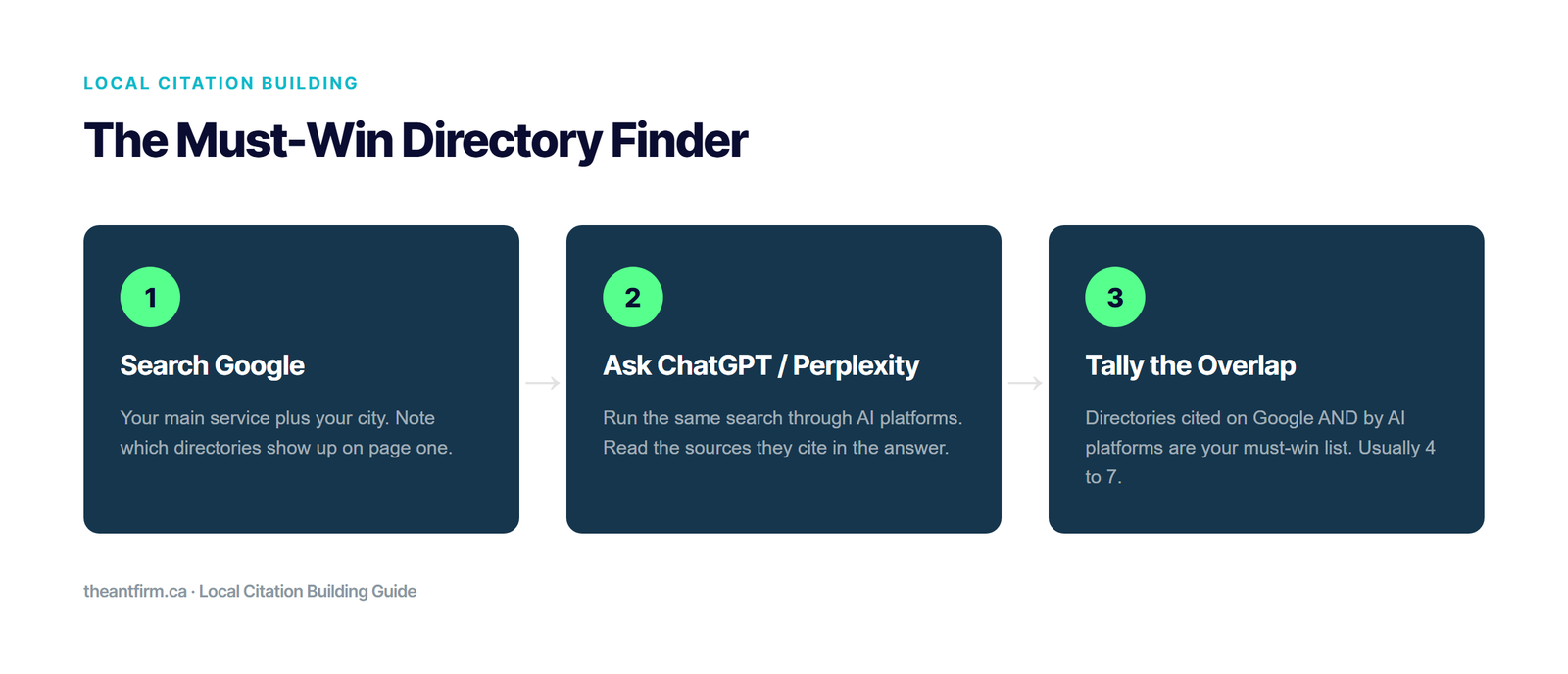
Search your main service plus your city, the way a customer would: “furnace repair Scarborough” or “plumber Toronto,” not just “furnace repair.” Note which directories show up on page one: for home services that’s often Yelp, HomeStars, or Clutch; for legal it’s usually Avvo, Justia, or Super Lawyers; for medical it might be Healthgrades or RateMDs. One name is worth checking no matter your niche: the Better Business Bureau. It’s one of the only generalist directories AI platforms still treat as a credibility signal across almost every industry, so don’t skip it just because it isn’t industry-specific. Then run the exact same search through ChatGPT, Perplexity, and Google’s AI Mode, and read the sources each one cites in the answer. The domains that show up across all three, ranking on Google and cited by more than one AI platform, are your must-win list. A source cited by three platforms out of three is worth far more attention than one that only showed up once. Most niches land on somewhere between four and seven of them, not fifty. If you’d rather have this checked for you instead of running the searches manually, our free AI Visibility Checker scores exactly this: crawler access, schema, and entity clarity, in under a minute.
Key Insight
Don’t stop at your own city. Run the same search for your service in a bigger, more competitive market: Toronto or the GTA if you’re in a smaller town nearby. The directories and sites mentioning top-ranking competitors there are often the same high-value sources worth pursuing for your own listing, and competitive markets surface them faster than a quiet local search will.
Audit NAP Consistency Before You Add Anything New
Adding new citations on top of existing mismatches just multiplies the confusion. Fix what’s already out there first.
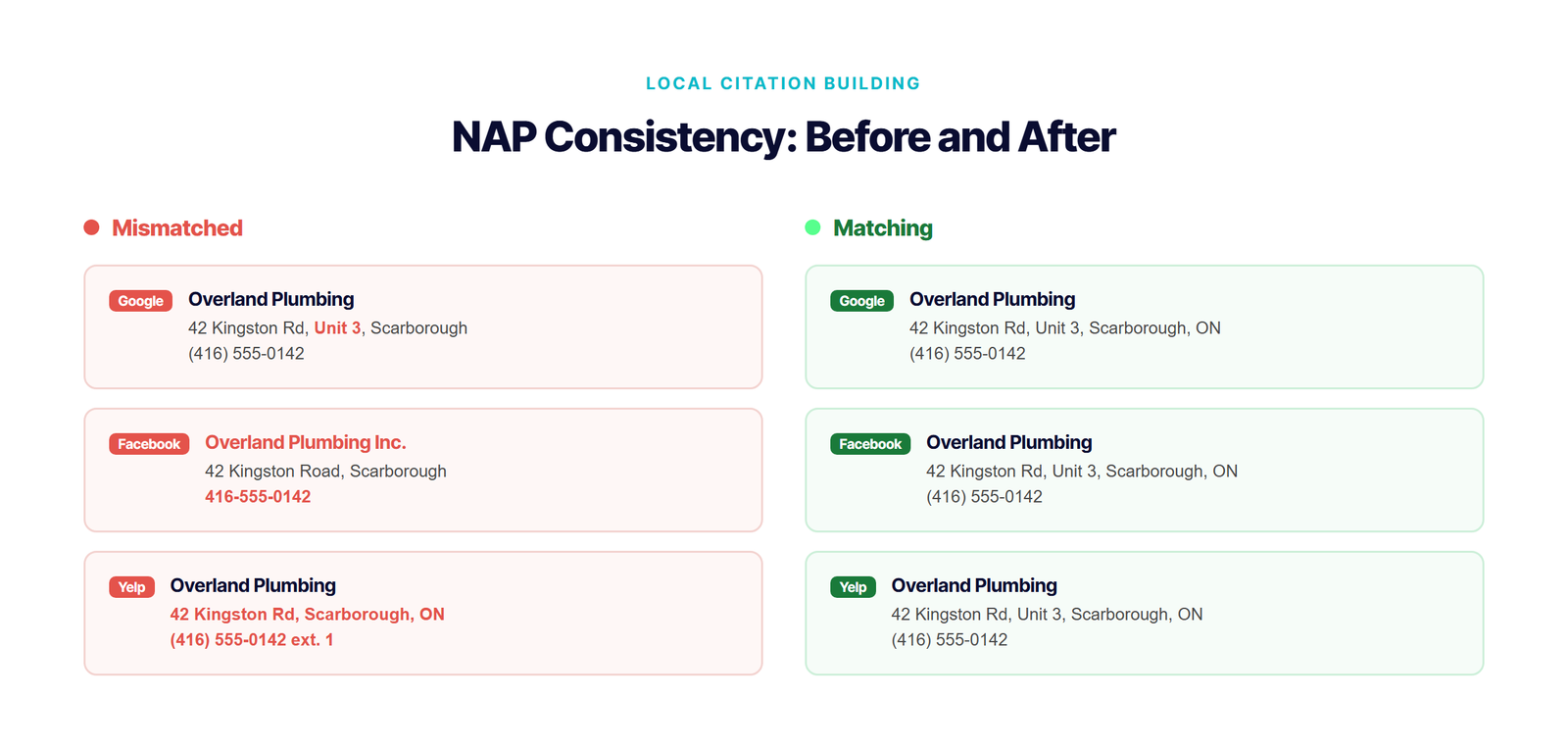
Pull up every place your business is currently listed, including Google, Facebook, your existing directory profiles, and even an old listing from a previous address, and put them side by side. Your business name, address, and phone number need to match exactly: same suite number, same phone format, same spelling of the business name, no “Inc.” on one listing and nothing on another.
Myth
“A small mismatch like a missing suite number doesn’t matter.” It matters more now than it used to. AI platforms build their answer about your business by cross-referencing multiple sources. If those sources disagree, the AI doesn’t average them out; it just repeats whichever version it found. A stale address on one directory can mean an AI platform confidently tells a customer the wrong location.
If your business isn’t showing up in the map pack at all, NAP inconsistency is one of the most common invisible causes. We cover the full list of reasons in why your business isn’t showing on Google Maps.
Claim and Build Out Your Must-Win Profiles
Your Google Business Profile is the anchor citation and should already be fully built out. If it isn’t, that’s worth fixing before anything else here. We’ve written a full guide on getting that specific profile right: the Google Business Profile advanced playbook covers categories, services, photos, and posts in depth. For every directory on your must-win list from Step 1, claim the listing if it exists or create it if it doesn’t, and fill in every available field: full category, exact hours, complete service list, business description, and photos. Most business owners fill in the required fields and stop. The gap between “claimed” and “fully built out” is exactly where the opportunity sits.
Write Descriptions AI Can Actually Parse
The sentence structure of your directory description matters more than most business owners realize.
Most directory descriptions read like marketing copy: a line about how long you’ve been in business, a line about customer service, maybe a slogan. That’s fine for a human skimming it, but it’s a poor match for how AI models extract facts from text. A more reliable structure is a simple subject-predicate-object sentence: [business name] is a [city] [service type] specializing in [specific service].
What does that actually look like written out?
“Overland Plumbing is a Scarborough plumbing company specializing in emergency drain repair and tankless water heater installation.” That one sentence names the business, the location, the category, and the specific services, in an order an AI model can extract cleanly. Everything else in the description (your story, your guarantees, your team) can follow after it, but lead with that structure.
Optimize Each Profile Like a Web Page, Not a Form You Filled Out Once
A directory profile can rank in Google on its own, separate from your website, but only if it’s actually written to, not just filled in. Run your profile description through any content optimization tool the way you’d run a blog post, see what topics it’s missing compared to competitors ranking in that same directory, and rewrite it to cover them. Most platforms allow somewhere between 150 and 500 words depending on their character limits. Use as much of that room as the platform gives you.
Route Reviews to the Directories That Matter, Not Just Google
Reviews drive both your Google local pack position and how often AI platforms recommend you, but only on the platforms those systems actually pull from. If Perplexity is citing Avvo and Justia for legal searches in your area, a stack of five-star Google reviews alone won’t show up in that answer. When you ask a happy customer for a review, point them at whichever of your must-win directories from Step 1 needs it most that month, not just whichever is easiest to ask for.
Check How Confident Google Actually Is About Your Business
Quick Check
Search your own business name directly in Google, the same way a customer would. If a Knowledge Panel shows up on the right side of the results, with your logo, address, and description, Google has a confident, established read on who you are. If nothing shows up, or what’s there is thin or outdated, your entity isn’t well established yet, and it’s worth cleaning up your business description and NAP consistency across the citations in this guide before expecting AI platforms to describe you accurately.
Don’t Overlook the Citations That Never Touch a Directory Form
Not every citation comes from filling out a listing. Sponsoring a local sports team, showing up on a community organization’s “our supporters” page, or getting mentioned on a neighbourhood association’s site are all unstructured citations, and they’re ones your competitors filling out directory forms are probably skipping entirely. Google and AI systems already trust these community and organizational pages, which makes a mention on one worth more than most directories you’d have to build from scratch. If the sponsorship cost fits your marketing budget, treat it as a citation-building line item, not just a community goodwill gesture.
Track Four Visibility Layers, Not Just One Ranking Number
This is the step that turns citation work into something you can actually measure instead of a task list you hope helped.
Before you build a single new citation, take a snapshot of where you currently stand, and track it as four separate layers, not one blended sense of “are we doing better.” Watching only your Google ranking, or only whether AI mentions you, misses most of the actual picture.
| Layer | What It Tells You |
|---|---|
| Traditional search ranking | Where your website itself ranks organically for the target keyword |
| AI answer mentions | Is your brand named when you ask ChatGPT or Perplexity the question a customer would, and where in the answer |
| AI citations | Is your domain, or a brand mention on someone else’s domain, actually part of the sources the AI pulled from |
| Local pack position | Where you sit in Google’s map-pack results for the same search |
Without a starting snapshot across all four, you have no way to prove any of this worked. Recheck every month or two. A jump in AI mentions with no local pack movement yet is still real progress, and you’d miss it entirely if you were only watching one layer.
Frequently Asked Questions
What is a local citation?
A local citation is any online mention of your business name, address, and phone number, usually on a directory, review site, or community organization page. Google and AI platforms both use citations to confirm you’re a real, consistent business at a real location. Citations are one piece of a bigger picture: see our local SEO guide for small businesses for how they fit alongside your Google Business Profile, reviews, and on-site content.
How many citations does a small business actually need?
Far fewer than most guides suggest. Four to seven well-optimized citations on the directories your niche and city actually get cited from will outperform fifty generic ones sitting mostly unfilled.
Do paid citation-building services work?
They can save you the time of manually claiming listings across dozens of sites, which has some value. What they don’t do is the research from Step 1: picking the specific directories Google and AI actually cite for your niche. A service that blasts your NAP to a hundred generic directories isn’t more useful than doing seven of the right ones yourself.
That’s the citation-building process that actually accounts for how Google and AI find local businesses today. Citations are one of ten checks in our free Website Audit Checklist, worth running through if you haven’t already. The last part is the one worth sitting with.
A Citation Only Works If Your Website Backs Up What It Says
Directories tell Google and AI who you are. Your website has to prove it, with the local schema, service pages, and content structure that make the claim actually land (see the local business website structure guide for what that structure looks like).
We build local-first websites with SEO, GBP, and local schema wired in from day one, so the local citation building work you do actually has something solid to point back to.
See How We Build Websites →