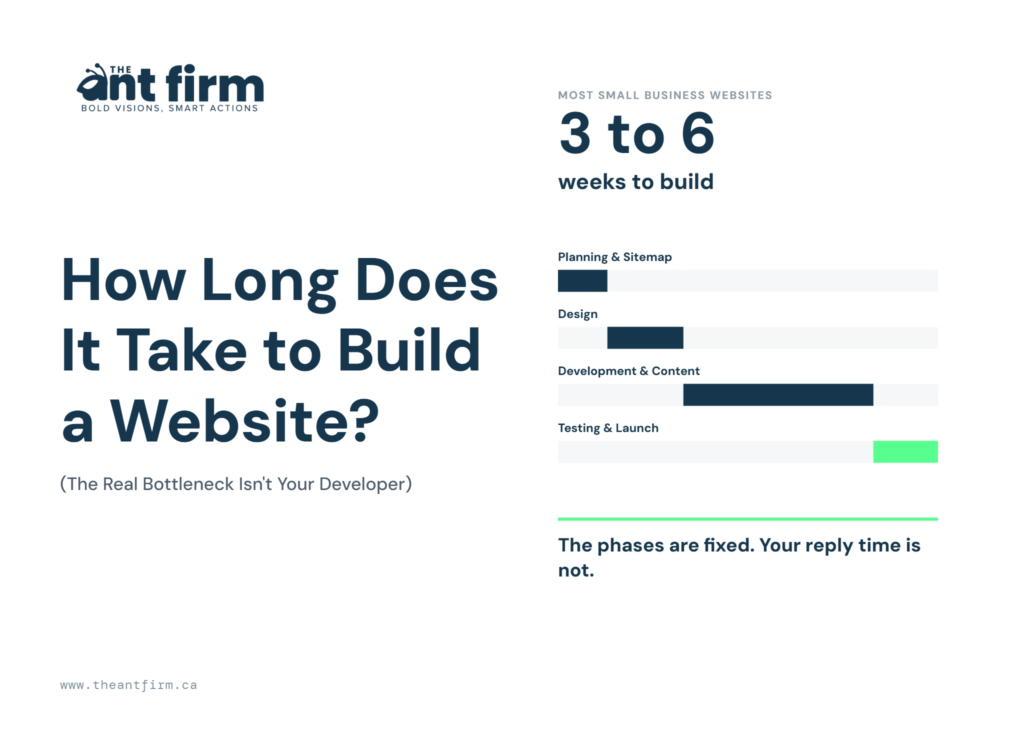
TL;DR: Most small business websites take 3 to 6 weeks to build, including an SEO focused site with 30 or more pages. Online stores and builds with more integrations can take 6 to 10 weeks. Delays often happen when the logo, photos, or website copy are not ready. Slow feedback can also push the timeline back. A well structured website needs time for page planning, SEO, schema, and Google Business Profile setup. To launch faster, have your content and brand materials ready before the project starts.
Introduction
If you are asking how long does it take to build a website, here is the real answer. Most small business websites take between 3 and 6 weeks to build. That includes a site with 30 or more pages built for search visibility. An online store or a build with more integrations usually takes 6 to 10 weeks. The 3 to 6 week range is the average delivery time across completed builds at The Ant Firm, not a guess copied from a vendor page.
Most guides give you the same non answer. They say it depends and move on to the next section. That answer does not help a business owner in the Greater Toronto Area who is trying to line up a launch before a busy season or a rebrand. A landscaper needs a site live before spring hits. A contractor needs one up before the fall rush starts. A retail shop needs one ready before the holiday season. Nobody planning around a real calendar date has time for a shrug. So here is a straight number instead.
Most guides also treat every website build the same way. They walk through generic phases and generic tools, and they never connect the timeline to your actual business. This piece does that instead. It tells you what a real build looks like, what actually slows it down, and what you can do about it before you ever sign a contract with anyone.
How Long It Actually Takes to Build a Website
A basic brochure site with 5 to 10 pages can be ready in 2 to 3 weeks. A full SEO structured build with 30 or more pages, proper schema, and Google Business Profile setup usually takes 3 to 6 weeks. An online store or a site with more integrations usually takes 6 to 10 weeks. The 3 to 6 week range comes from real finished projects. It is not vendor marketing copy dressed up as fact.
Every one of these ranges depends on one thing above everything else. It depends on you. The phases below are fixed. Your part of the process is not. That is the part most guides skip over. It is also the part that decides if your project lands on time or slips by weeks.
What Actually Controls the Timeline (Hint: It’s Not Just Your Developer)
The developer is not the only factor that affects your website timeline. Your content, feedback, and decisions can also speed up or delay the project.
Your Content Needs to Be Ready
The biggest delay often comes from missing content. Your logo, photos, and website copy should be ready before the project starts. Without them, writers and designers have to wait for the information they need.
Ready Content Keeps Things Moving
When everything is ready from day one, the project can move through each stage without long breaks. Missing files or content can add days or even weeks to the timeline.
Fast Feedback Helps
You will need to review the website at different stages. One person who replies quickly can keep things moving. If several people need to approve every change, even a simple review can take much longer.
Developer Timelines Stay Mostly Fixed
Planning, design, development, and testing each take a certain amount of time. Your response time is less predictable. Quick decisions can keep the project on track, while slow replies can add weeks.
The Same Project Can Take Different Times
Two businesses can start the same website project on the same day and finish at very different times. One may have its content ready and one person making decisions. The other may still be waiting for files and approvals. The developer follows the same process, but the second project can still take weeks longer.
The Build, Phase by Phase
Here is what actually happens at each stage of a real build, in the order it happens. Every phase below plays a part in how long it takes to build a website, and each one depends on the phase before it.
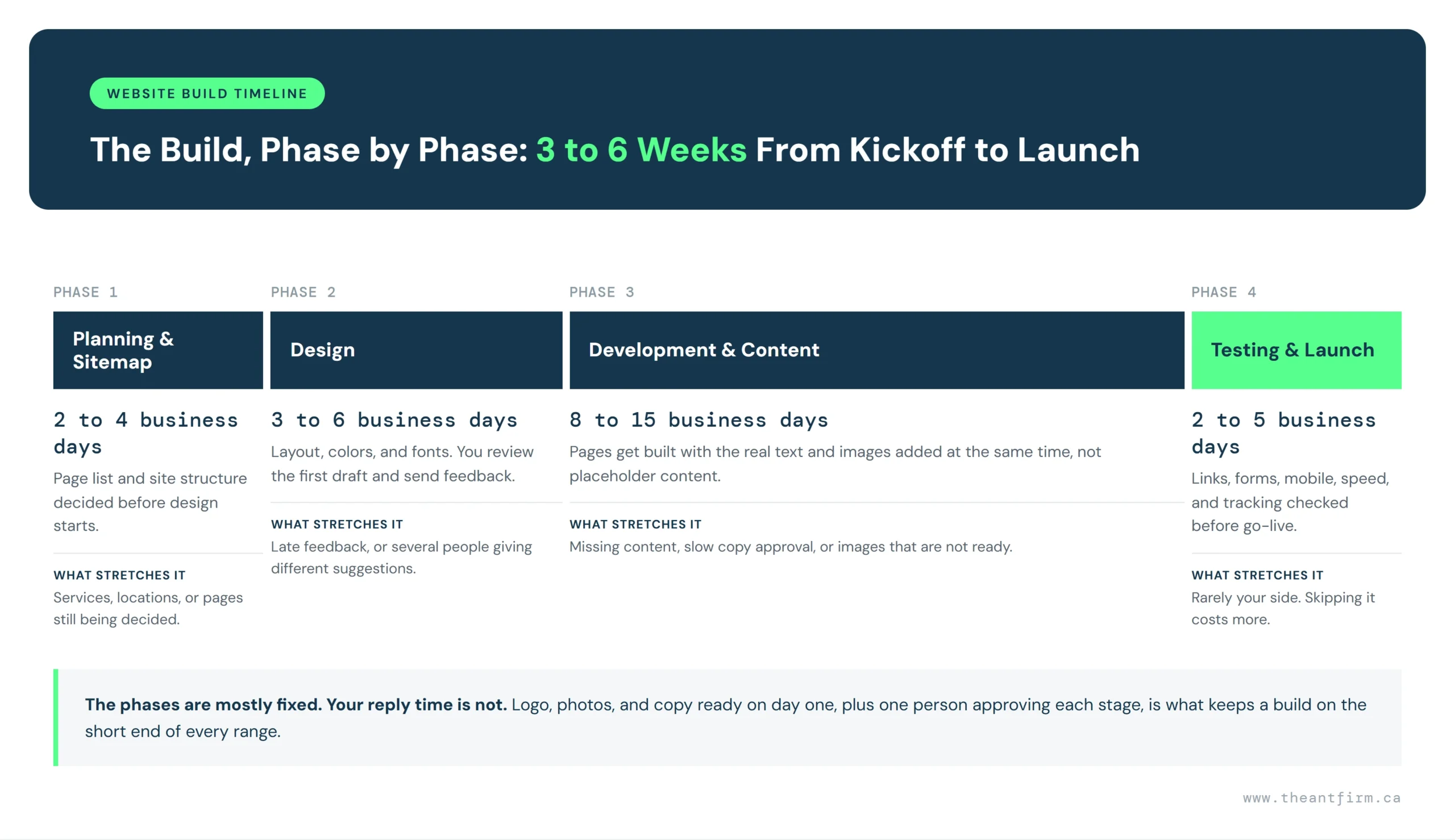
Planning & Sitemap
During planning, we decide which pages your website needs and how they will connect. This can include the homepage, service pages, location pages, and a blog or resource section. We plan the full website structure before starting the design.
We also decide which pages should target specific search terms. This helps us plan the number of pages and how they will be organized. This phase usually takes 2 to 4 business days. It can take longer if you are still deciding on your services, target locations, or adding new pages.
Having a clear page list from the start keeps this phase simple and helps the rest of the project stay on track.
Design
During design, you get to see how your website will look. We work on the layout, colors, fonts, and overall style of each page. You review the first draft and share your feedback, then we make the needed changes.
This phase usually takes 3 to 6 business days. It can take longer if feedback is delayed, the design keeps changing, or several people are giving different suggestions. Having your brand details ready and one person to give feedback can help keep the process simple and on time.
Development & Content
Development and content work usually happen at the same time. As each page is built, the real text and images are added. Using placeholder content can give a false idea of how the finished page will look and work.
This phase usually takes 8 to 15 business days, depending on the number of pages and features. It can take longer if content is missing, copy approval is slow, or images are not ready. Having the text and images prepared before development starts can help keep the project moving.
Testing & Launch
Before launch, we check every link, every form, and every page on desktop and mobile. We check page speed and confirm your site tracks correctly in analytics. We confirm your Google Business Profile and Search Console are connected and working, and we check that every page has the right title tag and meta description in place.
On a real build, this phase takes 2 to 5 business days. Skipping this step to save a day or two is one of the fastest ways to launch a site with broken forms or a Google connection that was never set up correctly.
Website Type Changes the Math
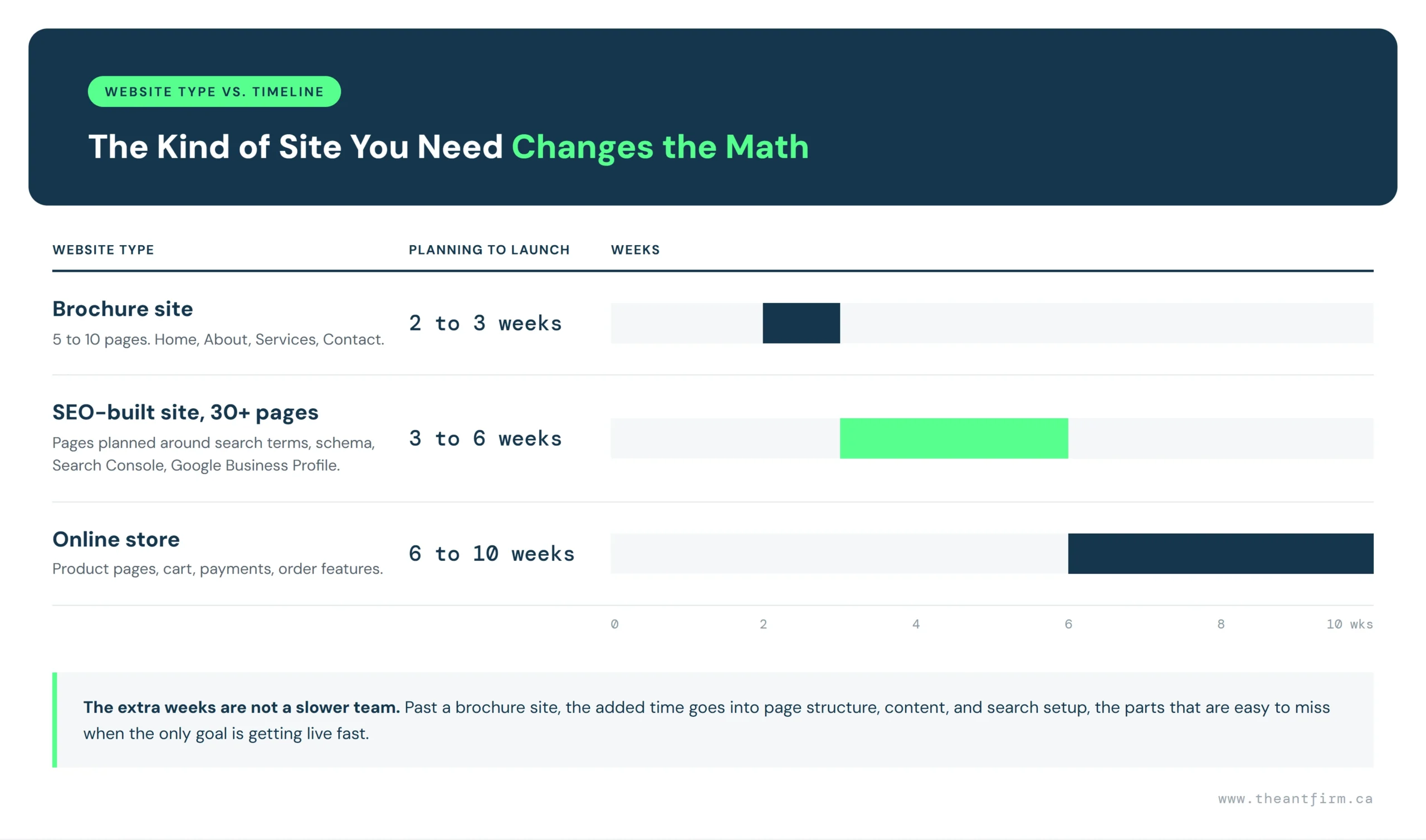
A brochure website with 5 to 10 pages is usually the quickest to build. It can take around 2 to 3 weeks from planning to launch. These sites normally have basic pages such as Home, About, Services, and Contact.
A small business website built with SEO in mind usually takes around 3 to 6 weeks, even when it has 30 or more pages. The work includes planning pages around search terms, setting up the site structure, adding useful content, and preparing important SEO details. Page count is only one part of the timeline.
An online store usually takes longer because it has more parts to set up. A site with product pages, a shopping cart, payment options, and order features can take around 6 to 10 weeks. The number of products and the type of store can also affect the timeline.
There is also a difference between building a site quickly and building one with long term search in mind. An AI website builder may help you create pages in a short time, but a properly planned SEO site needs more work behind the scenes.
An SEO focused website may include a clear page structure, relevant search terms, schema markup, Google Search Console, and a connected Google Business Profile. These steps help search engines understand the website and its pages. They are easy to miss when the main goal is getting the site live quickly.
A longer build does not always mean the work is being delayed. Some of that time goes into planning the pages, writing content, checking the site structure, and preparing it for search. Google also notes that new pages can take time to be crawled and indexed after a site goes live.
This is why website timelines can be very different from one project to another. A five page brochure site, an online store, and a 30 page SEO focused site need different amounts of work. Knowing what type of website you need makes it easier to get a realistic timeline before the project begins.
What You Can Do to Keep It On Schedule
You control more of this timeline than you think. Here is what actually moves the needle.
- Have your logo, photos, and written copy ready before the project starts. This one step removes the top cause of delay on any build.
- Decide on your full page list before planning begins. Changing your mind mid build adds days to every phase that comes after.
- Pick one person to give feedback and approve each stage. One decision maker replies faster than a group.
- Set a reply window for every review round, such as 48 hours, and hold to it.
- Send your photos and copy in one batch instead of a few files at a time. This keeps your project team from waiting on pieces.
The website build itself follows a set process, but your part can affect the timeline. If you are still asking how long does it take to build a website, check how ready you are before looking at the developer’s schedule.
Having your content, images, page list, and feedback ready can keep the project moving. Delays often happen when these things are still being decided during the build.
Get a Real Timeline, Not Another Guess
If you want a clear website timeline and budget, The Ant Firm offers fixed price website builds with the page count, scope, and timeline agreed on before the project starts. This means you know what to expect without hourly charges or unexpected changes along the way.
Need to know how long your website will take? Get a fixed price website build quote from The Ant Firm and get a timeline based on similar completed projects. Get your website build quote.
How Long Does It Take to Build a Website? Common Questions
How long does it take to build a 10 page website?
A 10 page website usually takes 2 to 4 weeks from planning to launch. The time can change based on the design, content, features, and changes needed. Having your content and images ready can help speed things up.
Can a website be built in one week?
A simple one page website can be built in a few days if everything is ready. A full business website usually needs more time for design, development, testing, and changes. One week is usually not enough for a complete website.
Does a bigger website always take longer?
No. The number of pages does not decide the whole timeline. A 30 page website with ready content can be finished faster than a 5 page website where the content and design are still being decided.
Does the type of website affect the timeline?
Yes. A simple business website needs less work than an online store. An online store may need product pages, payment options, shipping, and order features. These extra features can increase the development time.
What can delay a website project?
Waiting for content and feedback can delay a project. Adding new pages, changing the design, or asking for new features can also add time. Clear plans and quick feedback can help keep the project on schedule.