TLDR
Across 18 Ontario local businesses (8 dental clinics, 10 law firms), the average website health score was 36.6 out of 100. Every business shared the same core problem: their website only works for people who already know them. Strangers searching “dentist near me” or “real estate lawyer Richmond Hill” find competitors instead – despite years of operation, strong Google reviews, and genuine expertise. The most common website mistakes: no location-specific pages (18 of 18), no individual service pages (17 of 18), branded-only traffic (17 of 18), reviews hidden from the website (16 of 18), and a neglected Google Business Profile (16 of 18). None of these require a monthly retainer to fix. They require the right website structure, built once.
Earlier this year, I started sending free website audits to local businesses across the GTA. Dental clinics, law firms, trades, hygienists – any business that serves Ontario clients and depends on local search to grow.
After completing 18 of those audits, I kept seeing the same thing. The businesses weren’t making random, scattered mistakes. They were making the same mistakes. Almost exactly. Regardless of niche, years in business, or how strong their Google reviews were.
So I went back through all 18 reports, catalogued every issue, and grouped them by type, frequency, and niche. What you’re reading is what I found. This isn’t a post about generic “SEO tips.” It’s a pattern I observed across real GTA businesses, and it’s costing them real clients every single day.
The 18 Businesses: What We Looked At
All 18 businesses were located in the GTA — primarily Richmond Hill, Markham, and Vaughan. Two niches: dental clinics and law firms. Both are high-intent, local-first service businesses where a single new client is worth hundreds or thousands of dollars.
Each audit scored the business across four areas: Google Business Profile setup, organic search visibility, website structure, and overall health. The highest score in the entire group was 52. The lowest was 28. The average was 36.6 out of 100 — and only one business cracked 50.
A score of 36 means the website is technically alive but essentially invisible to anyone who doesn’t already know the business name. It’s not failing — it’s just not working.
1. No Location-Specific Pages — Serving Multiple Cities, Visible in None
Found in 18 of 18 audits — 100%
Every single business in this group serves clients across multiple GTA cities. Richmond Hill, Markham, Vaughan, Thornhill, Mississauga, Aurora — listed on a contact page or mentioned in passing. But every single one had zero location-specific pages built for any of them.
Google ranks pages, not businesses. If there’s no page targeting “real estate lawyer Vaughan,” Google has no signal to show you for that search — even if you’ve been practising real estate law in Vaughan for 15 years.
One law firm in the group serves clients across Richmond Hill, Vaughan, and Aurora — three separate local markets with separate search demand. The homepage mentions these cities. There are no dedicated pages. A competitor with a “Family Lawyer Vaughan” page will outrank that firm in Vaughan regardless of which firm is actually better.
2. Everything Crammed onto One Page — No Individual Service Pages
Found in 17 of 18 audits — 94%
Across 17 of the 18 businesses, all services were listed on a single page — sometimes a single paragraph. No individual service pages. No dedicated URLs. One page trying to rank for everything.
Google can only rank one page per keyword at a time. If your dental clinic does cleanings, whitening, implants, and emergency care — and they all live in a bullet list on the homepage — Google has no signal for which search to show you for. So it shows you for none.
“The design investment is real. The architecture is working against it.”
Each service needs its own page. Not a tab. Not a section. A dedicated URL with its own title tag, heading, and content. That’s how Google learns what you do — and shows you for the searches that matter.
3.The Website Only Works for People Who Already Know You
Found in 17 of 18 audits — 94%
In 17 of the 18 audits, when I pulled keyword rankings, I found the same pattern: the business ranked position 1 for its own name, and nowhere meaningful for anything else. Branded traffic only. Zero new client or patient discovery through search.
The 200 visitors a month your website gets? They already knew you existed. They came to find your phone number or check your hours. Your website didn’t acquire them — it just served them.
One dental clinic had 204 monthly visitors — 202 of them arriving via branded search. For “dentist Richmond Hill,” the search that actually brings in new patients, they were nowhere. That keyword gets 500+ searches a month in that area. Every one of those searchers went to a competitor.
One law firm had zero measurable organic traffic. Zero. A 5-star firm with 59 reviews at 4.9 stars — the strongest review profile of any business in this audit group. The audit note literally reads: “The best reputation of any law firm we’ve audited in Richmond Hill — and the worst online visibility.” The site was built on GoDaddy Airo, which doesn’t give Google control over title tags, meta descriptions, or page structure. Great reputation. Platform was strangling it.
4. Strong Google Reviews — Hidden from the Website
Found in 16 of 18 audits — 89%
These businesses had real reviews. Good reviews. Hard-earned from years of work — and 16 of the 18 weren’t surfacing any of them on their website.
One dental clinic had 88 reviews at a perfect 5.0 rating. The owner responds to every one personally. A potential patient clicks the website from Google Maps — and sees nothing. No social proof. Just a services paragraph and a phone number. That patient has no reason to choose them over the next result, and they move on.
Most people check a business’s website before calling. If the site doesn’t show reviews, they go back to Google, read what’s there, and often leave. Surfacing reviews on-site closes the deal before the phone rings. It’s not a technical fix — it’s a conversion fix.
5. Google Business Profile: Half-Setup, Fully Neglected
Found in 16 of 18 audits — 89%
The Google Business Profile is the most underused free tool in local SEO. It directly affects map pack rankings — those three listings that appear when someone searches “dentist near me.” Across 16 of the 18 businesses, it was either incomplete, inactive, or both.
The most common GBP failures in the data:
- No business description — Google doesn’t know what you actually do
- Service areas not defined — Google doesn’t know which neighbourhoods to show you for
- No posts or updates — profile looks abandoned; inactive listings get deprioritised
- GBP not claimed by owner — one firm had 50 years of history and an unclaimed listing
- Website not linked — one firm’s GBP was actively showing “Add website”
- Zero review responses — multiple businesses with 1-star complaints had zero public reply
One dental clinic had a detailed 1-star complaint with a specific patient grievance — visible to every potential patient searching the clinic name — and zero response from the owner. That’s not a review problem. It’s a trust problem, and it’s playing out in front of new patients every single day. GBP is free to set up correctly. It’s the highest-leverage move most of these businesses weren’t making.
6. No Blog, No Educational Content, No Reason for Google to Keep Coming Back
Found in 15 of 18 audits — 83%
15 of the 18 businesses had no blog, no educational content, and no resources section. In two cases, a blog existed but had been completely abandoned — one law firm’s last post was from January 2019. Google had long stopped prioritising it.
Content is how Google learns what you’re an expert in. A dentist who writes one piece answering “how much do dental implants cost in Richmond Hill?” owns a page targeting a real, high-intent search. A dental website with zero content can’t compete for that traffic. Competitors who publish consistently compound that advantage every month.
For law firms, the gap is especially costly. Questions like “what happens at a real estate closing in Ontario” or “do I need a notary or a lawyer for this?” get searched thousands of times a month across Ontario. The firm that answers them owns that traffic. The others don’t exist for those searches.
7. Websites from 2012–2017 Still Live — and Still Losing
Found in 13 of 18 audits — 72%
Nearly three quarters of the businesses in this group were running websites with designs from 2012 to 2017. Table-based layouts. Stock imagery. Copyright footers reading “© 2017.” One site still had a COVID-19 notice pinned in the main navigation in 2026. Another had dead Google+ links in the footer — Google+ shut down in 2019.
Google uses mobile rendering as its primary ranking signal. A site that doesn’t render properly on a phone is penalised. And practically: a new patient lands on your site and makes a judgment in seconds. A 10-year-old design tells them you haven’t invested in your business. That impression carries into whether they call or not.
The most severe cases: one dental clinic had 88 five-star reviews and a completely offline website — every patient who clicked the website link from Google Maps hit a dead end. Several others had SSL issues, with browsers showing “Not Secure” warnings on every page. For a dental clinic where patients submit personal health information, that’s not just an SEO problem. It’s an immediate trust problem that costs them before they even speak to anyone.
One clinic’s audit had no SEMrush data at all — N/A across every metric. The site structure and missing local SEO signals were so thin that the practice was effectively invisible. The reviews were genuine. The patients were loyal. The website wasn’t showing any of it.
How Dental and Law Firms Differ
The top mistakes were consistent across both niches. But each had patterns worth separating out.
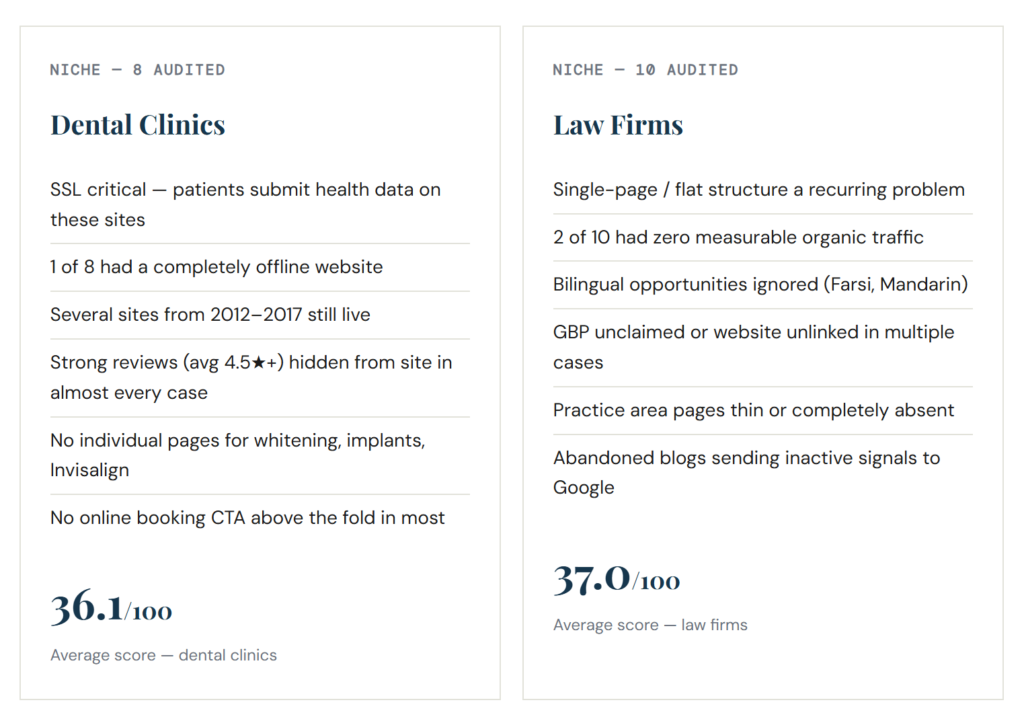
Two findings stood out in the law group specifically. First: a firm built on Wix had more real content than almost any competitor — a genuine blog, separate practice area sections, real client stories. The content was solid. But Wix limits how Google crawls and indexes pages, and it was holding rankings back from where they could be on a properly structured WordPress build. The content was doing the right things; the platform had a ceiling.
Second: two firms served significant Farsi-speaking and Mandarin-speaking client communities — rare, high-value differentiators in a competitive GTA market. Neither had a single page in that language, no mention of the bilingual offering in any title tag, and no dedicated page capturing those searches. Someone searching “Farsi speaking lawyer Richmond Hill” would never find either firm, despite that being their clearest competitive edge.
Three More Patterns Worth Naming
The seven mistakes above were the ones that showed up most often across all 18 audits. Three others came up constantly too, just not with the same frequency in this specific group – and they matter just as much once the structural issues are fixed.
Slow Mobile Load Times
More than half of the searches for these businesses happen on a phone. A site that takes six seconds to load loses the visitor before they see anything – reviews, service pages, location signals, none of it matters if the page never finishes loading. Compressing images and avoiding heavy page builders fixes most of this.
No Clear Next Step
A site can have the right pages and still lose the visitor at the last step – no visible phone number, no booking button, nothing telling someone what to do once they’ve decided to reach out. One consistent call-to-action, repeated on every page, is often the difference between a visit and a call.
Copy That Could Belong to Any Business
“Professional, reliable, experienced” shows up on almost every local business site and says nothing specific. The businesses in this audit with genuinely strong reputations, built over years and backed by real reviews, rarely used any of that reputation in their own copy. Naming the actual service, the actual city, and the actual response time does more than a paragraph of adjectives ever will.
What This Actually Means
The businesses in these audits aren’t failing. They’re busy, operational, with real clients and genuine reputations. The problem is that their online presence is only working for people who already found them through word of mouth or a referral.
Strangers — the patients and clients actively searching right now — are finding their competitors instead. Not because those competitors are better at their jobs. Because they have the right pages, the right structure, and the right signals in the right places.
“The reputation is there. The website isn’t carrying its weight.”
None of the top mistakes in this dataset are content quality problems. They’re not “your writing isn’t good enough.” They’re structural problems. And structural problems have structural solutions — built once, not paid for every month.
We saw this exact pattern with a business consulting client — a strong reputation built entirely on referrals, but nothing public to back it up. See how we built out their brand identity and website from a completely blank slate.
A site with individual service pages, a proper location structure, reviews surfaced on the homepage, a complete GBP, and SSL takes a few weeks to build correctly. After that, it works around the clock. That’s the compounding advantage these businesses are leaving on the table — every month they don’t fix it, a competitor with the right structure pulls further ahead.
Frequently Asked Questions
What are the most common website mistakes Ontario local businesses make?
Based on audits of 18 Ontario businesses (dental clinics and law firms across the GTA), the most common website mistakes are: no location-specific pages (found in every single audit), no individual service pages (94%), traffic that is almost entirely branded with zero new client discovery (94%), Google reviews not shown on the website (89%), and a neglected Google Business Profile (89%). These are not content quality issues — they are structural and architectural problems that can be fixed with a properly built website.
Is this a website problem or an SEO problem?
It’s a website structure problem — which is what makes it fixable without a monthly retainer. The mistakes identified here (no service pages, no location pages, no SSL, reviews not displayed) are built-in architectural decisions made when the site was first created. You don’t need someone billing you every month. You need a site built correctly from the start, with the right pages, the right technical foundation, and the right local signals. After that, Google does the compounding work over time.
How long does it take to see results after fixing these issues?
Structural changes — adding individual service pages, fixing SSL, building location pages — typically start showing results in Google within 4 to 12 weeks, depending on existing site authority and local competition. GBP improvements (completing your profile, posting regularly, defining service areas) can move map pack rankings faster, sometimes within a few weeks. No fix is overnight, but the businesses that correct these foundational issues compound their advantage every month they stay consistent. And every month they don’t fix it, a competitor who has is pulling further ahead.
Want to Know Where Your Site Stands?
We run the same audit — Google Business Profile, search visibility, website structure — for local Ontario businesses. No charge, no pitch deck. If something’s off, we tell you exactly what it is and what fixing it would look like. If everything’s fine, we tell you that too.