
You spend $2,000 on a new website and feel excited to launch it. The design looks modern, the pages load quickly, and everything seems to work perfectly. Then you wait for the leads to come in.
A few weeks pass. Then a few months. The phone stays quiet. The contact form gets little attention. Your website looks professional, but it is buried on page five of Google.
That is when someone asks a question that changes the whole conversation:
“Was SEO built into the website from the beginning?”
This is where SEO website development becomes important. A website can look impressive, but if search engines cannot properly understand it, potential customers may never find it.
In this blog, I will talk about what gets built into a website, what is often left out, and why those details can make a big difference in long term growth.
TLDR SEO website development means building search engine signals such as keyword structure, schema markup, page speed, and local visibility signals directly into a website during development so it can rank from day one without needing a separate SEO retainer. Most websites skip this because web design and SEO are treated as separate services. The result is that you pay for a website that nobody finds, then pay again for someone to fix it. When done properly, SEO website development combines both into one build.
What Is SEO Website Development?
SEO website development is the process of building search engine signals directly into a website during development, so it is visible on Google from the day it goes live.
It is not a plugin. It is not something you add later through a monthly retainer. It is a set of technical and structural decisions made while the site is being coded. Every page gets a unique title tag with a real keyword. Every heading follows a logical structure.
LocalBusiness schema tells Google your name, address, phone number, and service area before anyone searches for you. Images are compressed before upload. Pages link to each other so ranking power flows between them.
A site built with proper SEO website development does not need fixing after launch. It is built to rank from the first day Google indexes it. That is what makes it different from the $900 website you got six months ago.
An SEO ready website includes:
- Proper title tags
- Clear heading structure
- Schema markup
- Fast loading pages
- Internal links
- Mobile friendly design
- Location signals
Why Web Design and SEO Get Separated and Why It Costs You Twice
Most web developers are not SEO specialists. That is not a criticism. It is just true. A developer’s job is to build a site that functions, looks right, and loads on every device.
An SEO specialist’s job is to make that site findable on Google. These are different skill sets. And the industry has built itself around keeping them separate.
The Cost of Treating Them as Two Jobs
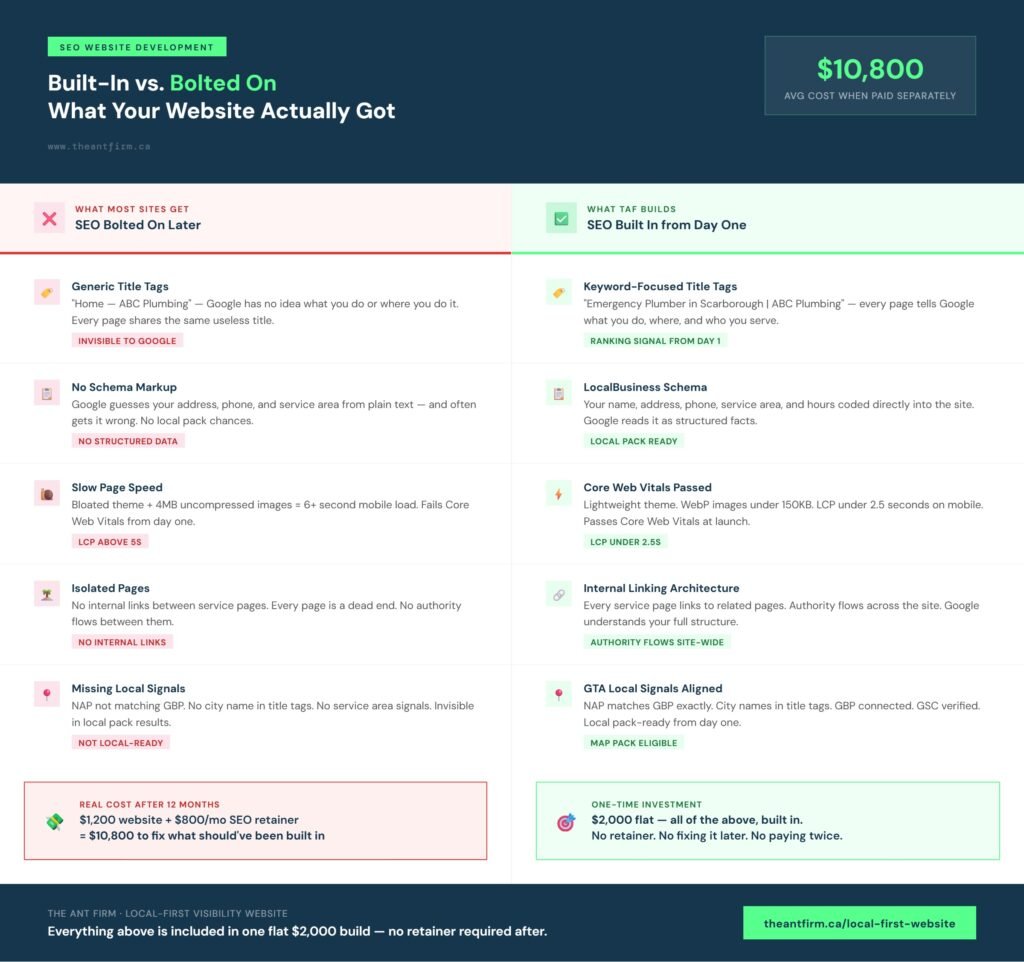
You pay $1,200 for a website. It looks fine. Three months later, no one can find it. You call an SEO agency. They audit the site and tell you it has no schema, no local signals, duplicate title tags, and no internal linking. They quote you $800 a month to fix it.
That is $1,200 plus $9,600 for a year of SEO retainer. You spent $10,800 to get what SEO website development would have given you from the start.
Website development and SEO treated as separate jobs do not just cost more money. They cost months of lost visibility. Every month your site sits on page five is a month your competitors are getting the calls that should be coming to you.
Why the Industry Keeps Getting Away With It
Web design agencies get paid to build sites and hand them over. SEO agencies get paid to manage rankings month to month. Neither one has a reason to offer the other’s service at a flat price. So businesses fall into the gap between them and end up paying both.
Agencies that deliver real SEO website development as a single, combined build are still rare. The conversation around SEO for web designers doing the full job has existed for years.
However, most developers never had the training to act on it. That gap is exactly where most GTA contractors and service businesses are losing money right now.
What Should Actually Be Built Into Every SEO Website
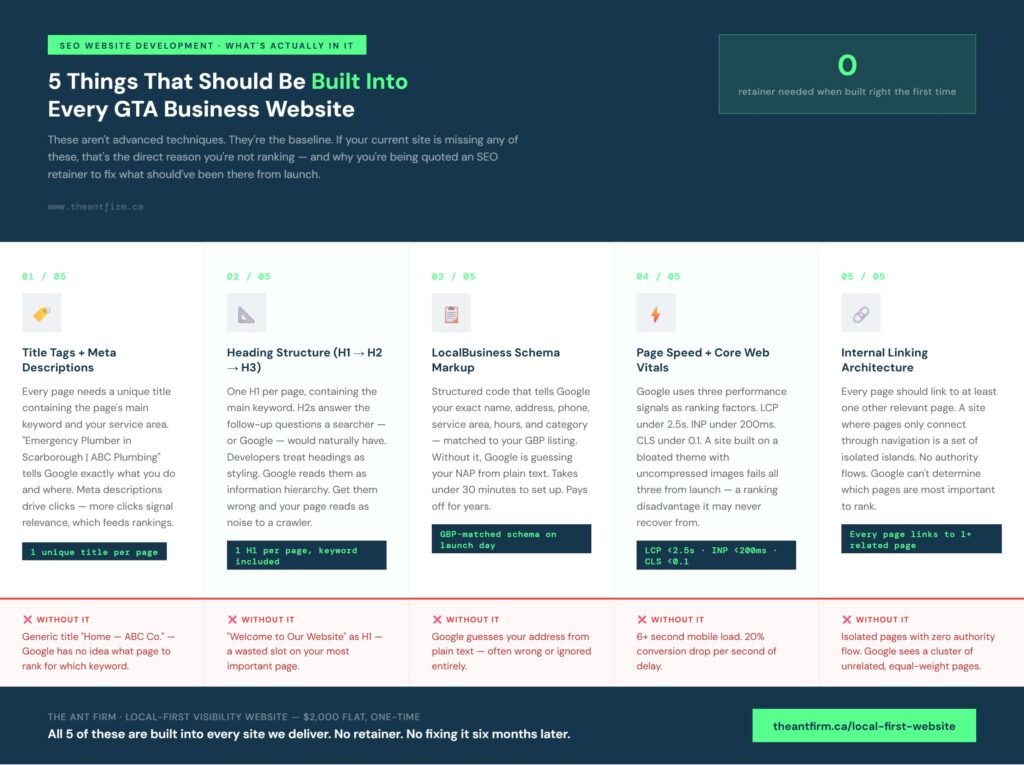
These are not advanced techniques. They are the baseline. If your current site is missing any of these, that is the direct reason you are not ranking.
Title Tags and Meta Descriptions
Every single page on your site needs a unique title tag. That title tag must contain the main keyword for that page and your city or service area.
If your home page title says “Home | ABC Plumbing,” Google has no idea what you do or where you do it. Change it to “Emergency Plumber in Scarborough | ABC Plumbing” and you immediately give Google and every searcher a reason to show your page.
Meta descriptions do not directly affect rankings. But they affect clicks. A meta description that names the reader’s problem and promises a clear answer gets more clicks than a blank one or an auto-generated one. More clicks signal relevance to Google. That feeds into rankings over time.
This is one of the most foundational elements of seo web design, and it is one of the first things that gets skipped when a developer has no SEO training.
Heading Structure
Each page needs exactly one H1. That H1 must contain the main keyword for that page. H2s and H3s should answer the natural follow-up questions a reader, or Google, would have on that topic.
A home page H1 that says “Welcome to Our Website” gives Google nothing to work with. An H1 that says “Plumbing Services in Scarborough, GTA” tells Google what the page is about, who it serves, and where it serves them.
Developers often treat H2s and H3s as styling choices. Bold text. Section dividers. Visual variety. That breaks the information hierarchy a search engine crawler looks for. The result is a page that looks organized but reads as noise to Google.
Schema Markup
Schema markup is structured code embedded in your site that tells Google specific facts about your business. For local service companies, LocalBusiness schema is the most critical type.
It gives Google your exact business name, street address, phone number, service area, hours of operation, and business category. When your LocalBusiness schema matches your Google Business Profile exactly, your chances of appearing in the local pack, the three-business map result at the top of Google, go up significantly.
Without schema, Google is guessing. It reads your page text and tries to figure out your address and phone number. Sometimes it gets it right. Often it gets it wrong or ignores the page entirely.
Schema is a core part of website development and seo done properly. Any developer offering real SEO website development will set this up as part of the build, not leave it for a plugin you configure later. It takes under thirty minutes to set up. It pays off for years. It should be in every site from day one.
Page Speed and Core Web Vitals
Google uses three performance metrics as ranking signals. LCP, which measures how fast the main content loads, should be under 2.5 seconds. INP, which measures responsiveness, should be under 200 milliseconds. CLS, which measures visual stability, should be under 0.1.
According to Google’s own research, a one-second delay in mobile page load time reduces conversions by up to 20%. A site built on a bloated WordPress theme with uncompressed images and five tracking scripts will fail all three metrics from launch day. That is a ranking disadvantage it may never recover from.
Page speed is not optional. It is a baseline requirement for any website development seo approach that actually works.
Internal Linking
Every page on your site should link to at least one other relevant page. A site where the only connections between pages are in the navigation menu is a set of isolated islands. No authority flows between them. Google cannot determine which pages are most important.
When your services page links to your contact page, your blog post on drain cleaning links to your emergency plumbing service, and your about page links to your service areas, you build a structure that tells Google how everything relates. Pages that get linked to frequently carry more weight. That weight flows outward to the pages they link to.
Internal linking takes planning during the build. It cannot be done meaningfully after the fact without rebuilding the content structure.
Local SEO Signals GTA Businesses Need from Launch
Most articles about SEO website development target developers or large agencies. They rarely explain what local businesses need, such as the search signals that help contractor web design, electrician sites, cleaning company sites, and gym sites appear in local results.
Let’s see why local SEO signals GTA businesses need from Launch
NAP Consistency
NAP stands for Name, Address, Phone. Your business name, address, and phone number must appear on your site exactly as they appear in your Google Business Profile. Not approximately. Exactly.
If your GBP says “ABC Plumbing Ltd.” and your website says “ABC Plumbing,” Google may treat them as two different businesses. That inconsistency weakens your local signals. This is one of the most common and most fixable mistakes in local seo web design.
City Names in Title Tags
If you serve Scarborough, Mississauga, and Brampton, your service area pages need those city names in their title tags. “House Cleaning Services in Scarborough | Your Company Name” is a local ranking signal. “House Cleaning Services | Your Company Name” is not.
One home page cannot rank for three different cities. Service area pages solve this. They should be part of the build, not something you add eight months later when you realize you are not showing up outside your own postal code.
Local Business Schema Aligned to Your GBP
Your LocalBusiness schema should include your street address, city, province, postal code, phone number, service area, business category, and hours. All of it should mirror your GBP listing exactly. This is what makes Google trust your information enough to show it in the local pack.
A cleaning company in Scarborough should have its city in the title tag of the home page, its address in LocalBusiness schema, and its GBP listing matching that exact information all in place before the site goes live.
How to Check If Your Current Site Was Built with SEO in Mind
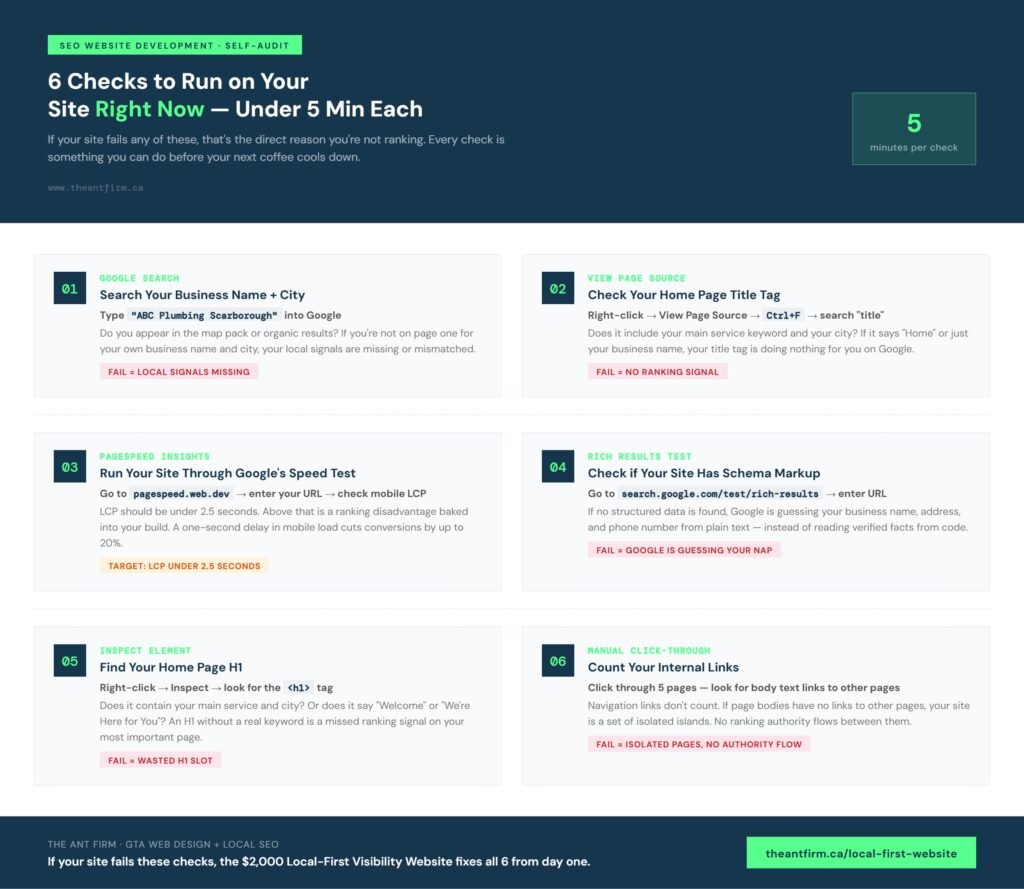
Run these six checks right now. Each one takes under five minutes. They will tell you exactly what is missing.
Step 1: Search Your Business Name and City on Google
Type “ABC Plumbing Scarborough” into Google. Do you appear in the map pack or in the organic results? If you are not on page one for your own business name and city, your local signals are missing or wrong.
Step 2: Look at Your Title Tag
Right-click anywhere on your home page and select “View Page Source.” Press Ctrl+F and search for “title.” Look at what is between the title tags. Does it include your main service keyword and your city? If it says “Home” or just your business name, your title tag is doing nothing for you.
Step 3: Run Your Site Through Google PageSpeed Insights
Go to pagespeed.web.dev and enter your URL. Check your LCP score on mobile. If it is above 2.5 seconds, your site has a speed problem that is holding back your rankings. This is one of the most common things missing from cheap builds.
Step 4: Test for Schema Using Google’s Rich Results Test
Go to search.google.com/test/rich-results and enter your URL. If no structured data is found, your site has no schema markup. Google is guessing your business details instead of reading them from code.
Step 5: Check Your Home Page H1
View your home page and inspect the element. Find the H1 tag. Does it contain your main service and your city? Or does it say “Welcome” or “We Are Here for You”? An H1 without a real keyword is a missed ranking signal on your most important page.
Step 6: Count Your Internal Links
Click through five pages on your site. On each page, look for links to other pages within the body text, not in the navigation. If you find none, your pages are isolated. No ranking power is flowing between them.
What to Ask Any Developer Before You Hire Them
These four questions separate developers who understand seo website development from those who have never thought about it. Ask them before you sign anything.
Question 1: “Will you set up LocalBusiness schema, or is that handled by my SEO person?”
A developer who does proper SEO website development sets this up during the build. A developer who says “that is an SEO thing” is confirming you will need to hire someone else after the site launches.
Question 2: “What CMS and theme are you using, and what is the average LCP for sites you have built on it?”
If they do not know what LCP means, that is your answer. If they use a heavy theme and have never tested its speed, you already know what you are getting.
Question 3: “Will each page have a unique title tag and meta description?”
This is a basic requirement. If the answer is “You can add those later in your SEO plugin”, SEO is an afterthought in their process. It will show in your rankings.
Question 4: “Does the build include internal linking between service pages?”
A developer who thinks about website development seo builds a linking structure between your service pages and location pages from the start. A developer who does not will hand you a set of disconnected pages with no authority flowing between them.
If a developer cannot answer these questions confidently, you are looking at a site that will need SEO work before it can rank. That means paying twice. These are exactly the elements covered in the Local-First Visibility Website, all included in a flat $2,000 build. No retainer required after.
What Happens When SEO Website Development Is Done Right
A contractor paid $900 for web design in Scarborough. The title tags said “Home.” No LocalBusiness schema. No internal links. Images uploaded at 4MB each. The site took over six seconds to load on mobile.
Six months in, the site ranked on page eight for its main service plus city keyword. Zero local pack appearances. Zero calls from organic search.
The site was rebuilt with proper SEO website development. Title tags updated with service and city keywords. LocalBusiness schema installed and matched to the GBP. Images compressed to under 150KB. H1s rewritten with real keywords on every page. Internal links added between service pages and location pages.
Within eight weeks, the site appeared in the local pack. No monthly retainer. No agency. The ranking came from the build. That is the difference between a site built for visibility and one built for appearance. It is also why seo for web designers and developers needs to be part of the conversation before the project starts, not after the site goes live.
End Note
In the end, most local service businesses don’t realize the real cost of a website until they try to get found on Google. A website can look nice, but if it is not set up for search, it often does not bring traffic and later needs more money to fix. The problem is usually not the design, but what was missing during the build.
Good SEO website development makes sure the website is ready for search engines from the start. This includes clear page titles, simple headings, schema markup, fast loading pages, and local SEO signals.
SEO website development should be part of every business website. When it is done from day one, the website has a better chance of showing up when people search for those services.
FAQ
Is SEO part of web development?
SEO should be part of web development, but often it is not. Web development is about building the website, including its structure, code, and features. SEO is about helping search engines understand and rank the site.
When these are done separately, one team builds the site and another fixes SEO later. This usually costs more and takes extra work.
SEO website development means doing both together from the start. It includes things like clean URLs, proper headings, schema markup, fast loading speed, and local SEO setup. This way, the website is ready for search engines from the day it goes live.
What should you avoid when developing a search-optimized website?
When building a search optimized website, there are a few common mistakes to avoid. One is using generic or duplicate title tags. Each page should have a unique title with the main keyword. Another is missing LocalBusiness schema, which helps Google understand your business name, address, and service area.
Slow loading pages are also a problem, often caused by large images or heavy themes. Google uses Core Web Vitals, so speed matters. A weak internal linking structure is another issue because pages that are not connected do not pass authority or help users navigate. Lastly, many businesses build the website first and think about SEO later. This makes it harder to fix structure and content issues.
How do web design companies optimize websites for speed and SEO during development?
Web design companies that build for SEO focus on speed and search from the beginning. They use simple, lightweight themes and clean code to keep the website fast. Images are made smaller and saved in modern formats like WebP. They also set up caching and a CDN before the site goes live to improve loading speed.
They write clear title tags and meta descriptions for every page using the right keywords. They add schema markup like LocalBusiness, Article, and FAQPage so Google can understand the site better. They also connect pages with internal links so everything is easy to navigate.
What is SEO in web design?
SEO in web design means building a website in a way that helps it show up on Google. It includes simple things like clear headings, image descriptions, clean URLs, mobile friendly pages, fast speed, and schema markup.
If a website is only made to look good, it may not rank well. But if SEO is added from the start, the site is easier for Google to understand and has a better chance of being found by people searching online.
Why is SEO important when building a new website?
SEO is important because it helps your website show up on Google when people search for your services. Without SEO, even a well designed website may not get traffic.
Good SEO helps search engines understand your pages through clear structure, keywords, fast loading speed, and proper setup, like schema markup. When SEO is included during development, your website has a better chance of ranking from the start instead of needing costly fixes later.
Is it better to pay once for a website or pay monthly?
A one-time build costs more upfront but you own the site outright, with no ongoing fees, no risk of losing your site if you stop paying. A monthly retainer costs less at the start but you’re renting: stop paying and the site (or its SEO work) often stops being maintained. If you want a site built correctly once with SEO baked in from day one, one-time ownership is usually the better long-term value.