
TLDR If your website is not showing up on Google, the cause is almost never a small technical fix. Google cannot see what you do or where you work. It needs clear location signals, clear service pages, and content that answers real local searches. Without this structure, Google cannot understand your site and will not rank it.
Introduction
You search your own business name and it shows up. But when a real customer types plumber in Scarborough or cleaner in East York’, your site is nowhere. Everything looks fine on the surface. The site loads. The pages are live. Yet you keep asking the same question: why is my website not showing up on Google?
The answer is almost never a missing plugin or a slow loading speed. The real reason is that Google cannot read your site clearly. It does not know what you offer, where you work, or who you help.
In the blog, I will talk about why this happens and exactly what to do about it. Here, You will learn the anatomy of a local business website.
Let’s begin the discussion.
First: Rule Out the Technical Stuff
Before going further, run a quick check. Type site:yourdomain.com into Google. If your pages appear, Google can reach your site.
Then open Google Search Console. Go to the Coverage section. Check for crawl errors. Make sure your robots.txt file is not blocking Google. Confirm your sitemap is submitted and active.
If all of this looks fine, the technical side is not your problem. Move on. The real issue is structure and content, which is the most common reason why a website is not showing up on Google.
Why Your Website Is Not Showing Up on Google
Most small business sites have three to five basic pages. A home page, an about page, a contact page, and maybe one services page. That is very little for Google to work with.
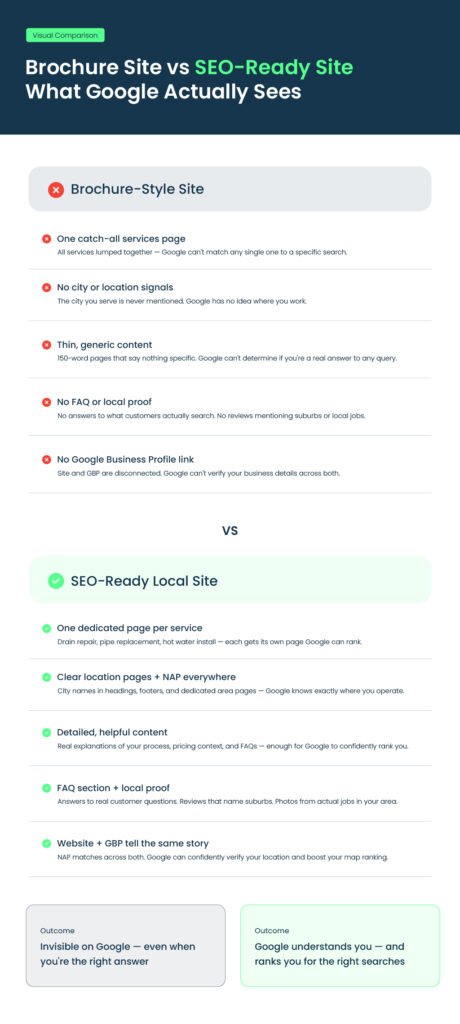
Google needs to match your pages to what people are searching. When your site has no city names, no individual service pages, and thin content, Google cannot connect your site to local searches. You end up invisible even when someone in your area is searching for exactly what you offer.
Here, the website design matters too. If your website is not well designed according to the location, then the chances for ranking get lower. Suppose you need a proper web design in Toronto to offer services there. Otherwise, because of the web design, your website will not show up.
The good news is that this is fixable. You just need to know what is missing.
Top 10 Reasons Your Website Is Not Showing Up on Google
Let’s explore the top 10 reasons to learn the answer to why your website isn’t showing up on Google:
1. No clear service pages
If you list every service on one page, Google cannot understand each one clearly. A plumber offering drain cleaning, pipe repair, and hot water installation needs three separate pages, not three bullet points on one page. People search for specific services. Google needs pages that match those specific searches.
2. No location signals
Google cannot guess where you work. If your site never mentions your city or suburb, Google will not connect you to local searches. Your heading, your page content, and your footer all need to name the areas you serve.
3. Weak content
Short pages look empty to Google. A 150-word services page tells Google almost nothing about what you do, how you do it, or who you help. Stronger content gives Google the detail it needs to rank you for the right searches.
4. No city or area pages
If you serve more than one location, you need a separate page for each one. A page titled Kitchen Renovation in North York will rank far better for that search than a generic services page ever will.
5. Low authority
Google checks authority before ranking a site. Authority comes from other websites linking to yours. If no one links to you, Google sees your site as unproven. Local links from suppliers, partners, or directories are a good starting point.
Related read: How to rank higher on google local services?
6. A brochure-style website
A clean five-page site with no detail is called a brochure site. It looks nice but gives Google almost nothing to rank. Google wants real service explanations, real location details, and real proof that you know your trade.
7. No NAP signals
NAP stands for name, address, and phone number. These three details need to appear clearly and consistently on your site. Google uses your NAP to confirm that your business is real and located where you claim.
8. No FAQ content
Customers ask the same questions every day before they hire someone. How much does it cost? How long does it take? Do you work in my area? A strong FAQ section answers these questions and gives Google more content to match against real searches.
9. No connection to your Google Business Profile
Your website and your Google Business Profile need to point to each other. When they are disconnected, Google has a harder time confirming your business details. This hurts both your map ranking and your website ranking.
10. No proof of service areas
Mentioning a city once is not enough. Google looks for real proof that you work there. Customer reviews that name a suburb, photos from local jobs, and case studies from real clients all help Google trust your location claims.
Related Read: We Audited 18 Ontario Local Businesses. Here’s What’s Quietly Killing Their Visibility
Comparison Table on Brochure-style site and SEO-Ready Local Site
This table shows the differences between a brochure site and an SEO-ready one that will not rank and one that will.
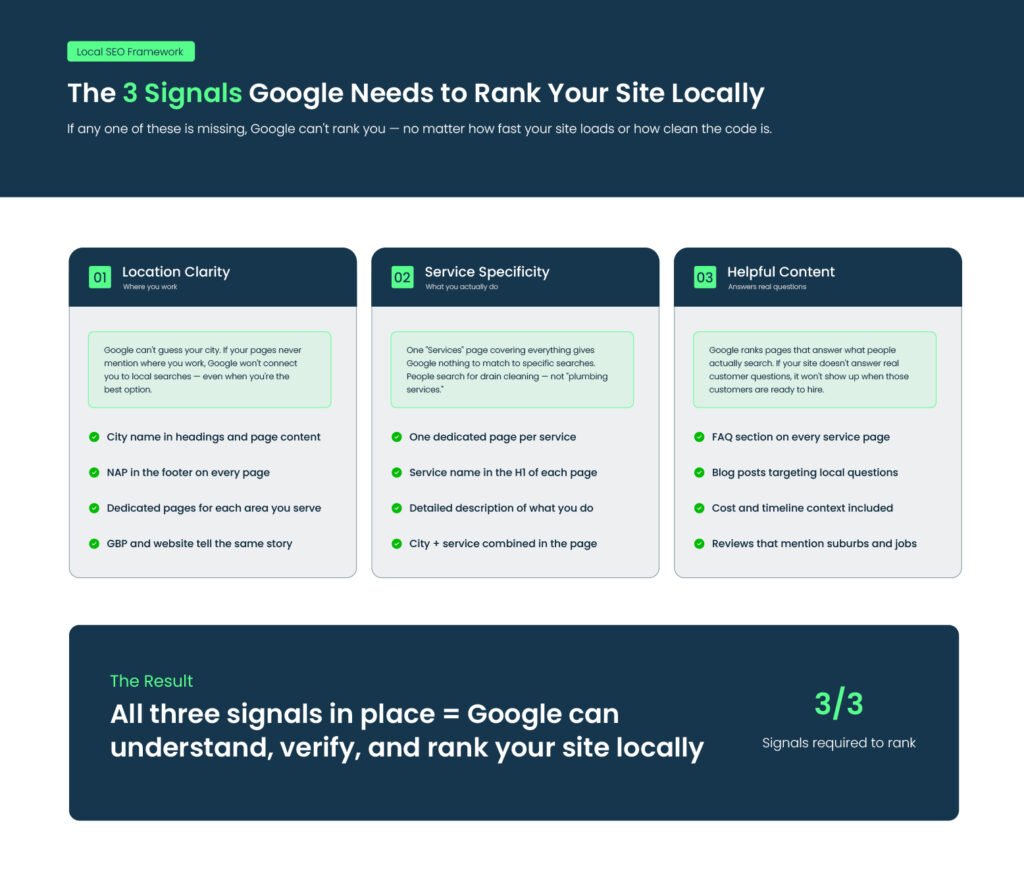
What Google Needs to Rank Your Site Locally
Google needs three clear signals from your site.
Clear location signals
Your pages must show your city, your address, and your phone number. Google cannot guess this information. It reads it from your content.
Clear service structure
Google wants to match pages to searches. One page with ten services does not help. One page per service does.
Content that answers real local questions
People search with questions. Your content needs to answer those questions. FAQ sections and blog posts show Google that you understand your customers.
These three signals form the foundation of local ranking. Without them, you will keep wondering why is my website not showing up on Google and never get a clear answer.
A Real Example of What This Looks Like
A roofing company in Scarborough had a five-page website. Home, About, Services, Gallery, Contact. The site had been live for two years and received almost no traffic from Google.
After adding individual service pages for roof repair, flat roof installation, and eavestrough replacement, plus separate pages for Toronto, Pickering, and Ajax, traffic increased significantly within four months.
The NAP was added to the footer. A FAQ section answered common questions about cost and timelines. Reviews from local customers mentioned suburb names.
None of these changes required a redesign. They required structure. That is the difference between a site Google cannot read and a site Google can rank.
Related Read: Why Your Website GetsTraffic But No Calls
Why Technical Fixes Will Not Fix a Structural Problem
Sitemaps help Google find your pages. Alt tags help Google read your images. Fast load times help the visitor. These things matter, but they do not replace structure.
A site with no service pages, no location pages, and no helpful content cannot rank. It does not matter how fast it loads or how clean the code is. Google reads the structure first. If the structure is missing, the technical fixes do nothing for your ranking.
This is the part that most guides skip. They tell you to fix your page speed and submit a sitemap. Those are maintenance tasks. They are not the reason why is my website not showing up on Google. The reason is that Google cannot understand what you do and who you serve.
Frequently Asked Questions
Q: How do I get my website to show up on Google?
Start by setting up Google Search Console, verifying your domain, and submitting your sitemap so Google can find your pages. That gets your site indexed, but it does not guarantee visibility in local searches. To show up for searches like plumber in Scarborough, your site needs proper service pages, city-focused content, and strong location signals. Without that structure, Google may index your site but still not rank it for the searches that bring real leads.
Q: Why is my website indexed but not showing up in search results?
Indexing and ranking are two different things. Indexing simply means Google knows your site exists. Ranking means Google sees your site as a strong answer to a specific search. If you are not appearing, the issue is almost always content. A single generic Services page, no city pages, no FAQs, and no structured data leaves Google with nothing solid to match to local searches. To rank, your site needs clear, specific, and helpful content that aligns with what people are actually searching for.
Q: How long does it take for a website to show up on Google?
Indexing usually happens within a few days to a few weeks after you submit your sitemap. Ranking takes longer, especially for competitive searches like HVAC company in Mississauga or roofer near me. Most local sites take around three to six months to gain traction when they have proper structure and content. If your site has been live longer than three months and still isn’t showing up for anything relevant, the delay is not the issue. The real problem is that your site likely lacks clear service pages or strong location signals.
Q: Why is my local business website not showing up on Google Maps?
Your Google Business Profile plays a big part in Maps visibility, but your website supports it. If your site does not clearly show your business name, address, phone number, and the areas you serve, Google struggles to confirm your location and match you to nearby searches. Even a fully completed profile can be held back by a weak or inconsistent website. Both need to align so Google can clearly understand who you are, where you operate, and what you offer.
Q: Do I need separate service pages to rank locally?
Yes, you do. If you offer more than one service, each one deserves its own page so Google can clearly understand what you specialize in. When everything is lumped into a single Services page, Google has very little to match with real searches.
Q: Can I rank in multiple cities if my business is only located in one?
Yes, it’s possible. To show up in nearby cities, your site needs proper location pages that explain what you offer in each area. Google won’t rank the same generic homepage for several cities, so these location pages help you connect with customers in places you want to serve.
Q: Why are other websites ranking higher than mine even though mine looks better?
Because rankings come from structure and clarity, not design. A simple site with strong service pages, clear location signals, consistent contact details, and helpful content can outrank a better-looking site that lacks those basics. Google rewards clarity over appearance every time.
End Note
In the end, now you know the real answer to why is my website not showing up on Google. It is the structure. Google needs clear service pages, location details, and helpful content to understand your business and match it to local searches.
A site with the right structure will rank. A site without it will stay invisible no matter how good the design is. Fix the structure first. Everything else follows.
If you are not sure what your site is missing, a free website audit can show you exactly where the gaps are and what to fix first.
Get a free website audit today and find out what is holding your site back.